
A starting point / 01–03
Keep.
Change.
Find out.
What deserves to stay?
What is getting in the way?
What do we need to understand?
01 / Before the brief
Give the change
a reason.
“We need a new website” starts a conversation. It leaves the most useful question open: what should become easier for the people who visit it, and for the team who looks after it?
For a cultural organisation, the answer might involve finding a resource, understanding a programme or moving from a story to an event. Choose a specific task before choosing a feature.
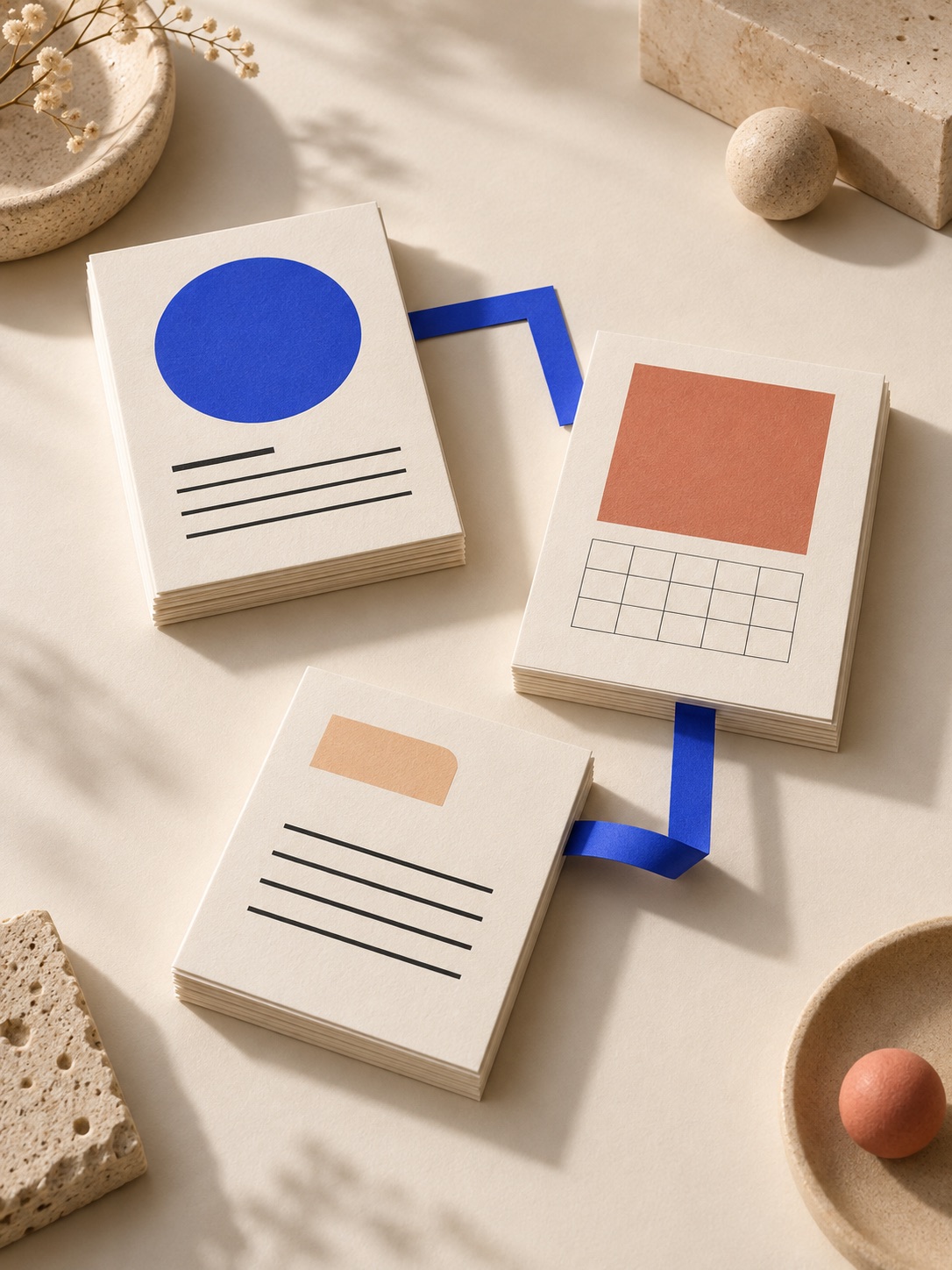
Illustrative study
Content,
connected.
Stories, events and resources.
Different pages. A clearer route between them.
03 / An illustrative example
From “a new look”
to a useful question.
Imagine a cultural organisation with an archive of stories, an events programme and practical resources. The team suspects readers struggle to move between them. This is a fictional example to work through, rather than a report of a client project.
Keep: consider retaining the stories and their credits, after checking their relevance and permissions.
Change: explore a clearer route from a story to a related event or resource.
Find out: can readers find the next relevant item, and can editors maintain those connections?
05 / Structure is part of the work
Give the content
a way to connect.
In The Wick, our work on website development and editorial structure distinguishes editorial formats, subject topics and stories. Thinking about those relationships helps explain what the website needs to hold, beyond the appearance of an individual page.
The design is by Praline. This is a reference to the published project, rather than a reconstruction of its original brief.
For your own site, list the content that exists, what needs reviewing and what still needs to be made. Name the person who can approve it and the person who will maintain it.
06 / Keep the brief proportionate
A starting sheet.
Room to go deeper.
A redesign does not automatically require replacing every part of a website. CharityComms’ 2025 brief retained WordPress and its domain, and separated a content audit from the redesign scope.
Other commissions need more detail. Irish Red Cross’s website tender includes discovery, content planning and training. The right amount of preparation depends on the work and the way it will be commissioned.
The sheet below is a way to begin a conversation. It can sit alongside a fuller brief when one is needed.
07 / Your starting sheet
Copy these prompts.
Keep the gaps.
Use these prompts in a document or a conversation. Leave anything you cannot answer as an open question.
- Reason. Why are we considering a change? What have we actually observed, and where does that evidence come from?
- People and task. Who most needs help, and what should they be able to understand, decide or do?
- Keep. What already works for those people or for our team? What supports that judgement?
- Change. What gets in the way, and which part of the content or journey does it affect?
- Find out. What are we assuming? Who could help answer the question, and what would we look at?
08 / Make it workable
Agree who does what.
Then take one step.
- Content. What do we have, what needs reviewing and what needs creating? Who approves it and maintains it?
- Constraints. Which systems, access needs, budget or dates shape the project? What are we leaving outside this first piece of work?
- Next step. What will we do next, who will do it and when? How will we check whether the change helped?
Our first question is: ____________________
The evidence we need is: ____________________
Our next step is: ____________________
You do not need a finished brief to talk to us. Bring the parts you understand and the questions you want to work through. Our strategy and web design work can start there.
References / Further reading
CharityComms — website redesign brief, 2025 (PDF); Irish Red Cross — website redesign tender (PDF). These are examples of commissioning documents, not claims about project outcomes or notices of currently open opportunities.
Written September 2026. The starting sheet and illustrative example were developed for this Note.